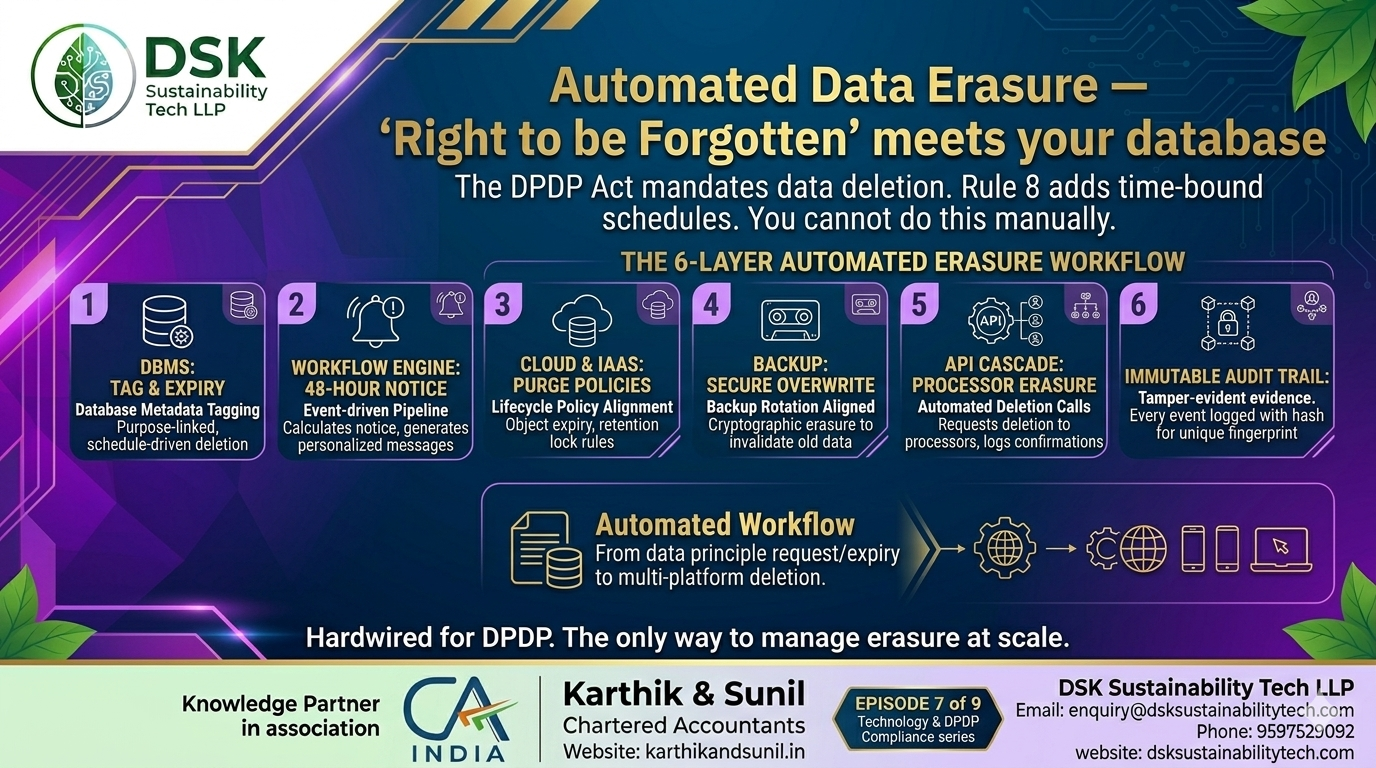
Automated Data Erasure — ‘Right to be Forgotten’ meets your database
The DPDP Act creates three erasure triggers: consent withdrawal (Section 6(6)), purpose no longer served (Section 8(7)), and Data Principal’s explicit request (Section 12(3)). Rule 8 sets time-bound schedules — with a 48-hour advance notification obligation before erasure executes. None of this can be managed manually at scale. Here is the technology layer that delivers compliance:
1. Database Management Systems (DBMS) — the primary execution layer Erasure begins at the database. DBMS platforms must be configured to execute purpose-linked, schedule-driven deletion — not just on-request DELETE queries. Tables holding personal data must be tagged with purpose metadata and retention expiry dates. When the trigger fires, the DBMS executes the deletion, and the action is recorded in the database audit log — creating the evidentiary trail needed under Rule 8.
2. Automated Workflow & Notification Engine — the 48-hour obligation Rule 8(2) requires the Data Principal to be notified at least 48 hours before erasure. An automated workflow engine must track each Data Principal’s retention expiry date, calculate the 48-hour notification window, generate personalised communications, dispatch them through the registered channel, and monitor for re-engagement that pauses the erasure clock. At millions of users, this is an event-driven pipeline — not a calendar reminder.
3. Cloud Storage & IaaS Lifecycle Policies — extending erasure beyond primary databases Personal data does not live only in the primary database. Cloud object storage (IaaS platforms) and SaaS data stores must have retention lifecycle policies configured to align with DPDP schedules. Cloud providers offer native lifecycle management features — object expiry rules, retention lock policies — that can be configured to automatically purge personal data after the specified period, including across data lakes and unstructured storage.
4. Backup Management — the most overlooked erasure surface Backup policy must define retention periods, and after completion of the retention period, data should be destroyed safely and securely. Under DPDP, this obligation extends to personal data in backup sets. Backup rotation schedules must be aligned with DPDP retention periods. Backup data must be invalidated or overwritten on schedule — using cryptographic erasure
5. API-Based Processor Erasure Cascade – Under Section 8(7)(b), erasure must cascade to every Data Processor holding that personal data. The erasure workflow must trigger automated API calls to cloud providers, analytics vendors, and third-party systems — requesting deletion, receiving confirmation, and logging the response. The Configuration Management Database (CMDB) maintains the asset inventory that maps which processors hold which personal data — making it the master reference for the erasure cascade workflow.
6. Immutable Audit Trail — the compliance evidence layer Every erasure event — trigger type, data erased, timestamp, processor confirmations — must be written to a tamper-evident audit log. Hash functions should be used to generate a unique digital fingerprint for system logs to ensure they have not been altered — This log is the Data Fiduciary’s evidence before the Board.
The ‘Right to be Forgotten’ is not a form on your website. It is a six-layer technology workflow hardwired into your data infrastructure.
Disclaimer
The contents of this post are intended for general awareness and informational purposes only. They do not constitute legal opinion, professional advice, consultancy, statutory interpretation, or a recommendation to act in any particular manner.
The Digital Personal Data Protection Act, 2023, related rules, notifications, regulatory guidance and judicial interpretations may evolve from time to time. The applicability of the law may also vary depending on the facts, sector, nature of data processing, organisational role, contractual terms and compliance framework.
Readers should not rely solely on this post for making legal, business, HR, technology, data-processing or compliance decisions. Specific advice from a qualified legal, privacy, cybersecurity, governance or compliance professional should be obtained before acting on any matter discussed.
The author / publisher shall not be responsible for any loss, liability, claim, penalty or consequence arising from reliance on the contents of this post without independent professional advice.
Leave a Reply